Environmental changes can be predicted with next-generation wireless sensor networks.
Wireless sensor networks have been developed that can monitor acres of land and water to observe pollution, humidity levels, and chemical composition.

Wireless sensor networks have been developed that can monitor acres of land and water to observe pollution, humidity levels, and chemical composition.
Supratik Guha, a professor at the Pritzker School of Molecular Engineering (PME) at the University of Chicago and a senior consultant at Argonne National Laboratory, developed wireless sensor networks. Guha believes these systems will reveal much-needed data about the planet's rapidly changing composition.
Supratik Guha commented on the matter: “These sensor networks will provide real-time, high-density data necessary to create an accurate picture of an ecosystem. We want to see how rivers are polluted, how much fertilizer is leaching from the soil. With better data, terrestrial ecologists can develop better nitrogen and carbon dioxide cycle models. Farmers can use exactly the right amount of water at the right time.”
In agriculture, small data points can have far-reaching effects. Volumetric water content determines how much water is absorbed by a particular patch of land and whether a farmer should irrigate their field today. Too little water can cause plants to wither, while too much can exacerbate soil erosion, wasting resources and polluting downstream supplies. The same can be said for terrestrial ecology. However, obtaining high-quality data on short-term environmental changes seems difficult in the near future.
Taking advantage of the emergence of cheaper sensors and low-power wireless systems like Sigfox, Professor Guha and his team created three separate environmental sensor networks under the name Project Thoreau. The first monitors water quality in several Indian rivers, the second records soil moisture around the University of Chicago campus, and the third collects year-round soil data at a pilot farm near Fermi National Laboratory in Batavia, Illinois.
PhD student Gregory Grant shared his thoughts on the project: “By placing sensors discreetly in a field, a national forest, or a nature reserve, we can monitor water quality or soil temperature. In a place like California, this is a powerful tool for monitoring wildfires or assisting with agricultural management. We can make informed decisions about excessive water use, fertilizer runoff, and pollution that we might perceive as hazards. There’s so much we can learn here.”
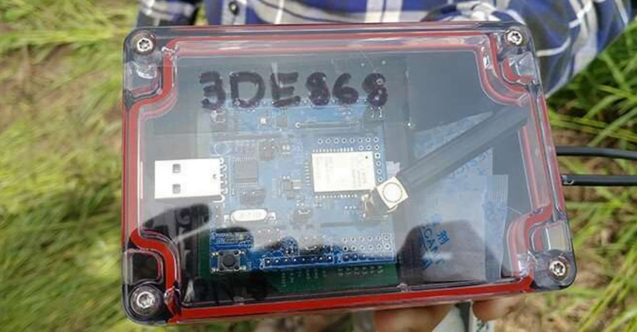
Sensor technology is rapidly evolving, and the specific components used in each of the Thoreau networks have changed over time. The Fermi farm network (Thoreau 2.0) uses a relatively inexpensive soil sensor connected to a plastic-coated circuit board. Each of the farm's 23 nodes is buried 1,5 meters below the surface, where they detect the volumetric water content, temperature, and electrical conductivity of the soil. Four AA lithium-ion batteries power the nodes, giving them roughly four and a half years of operational life. The key to the sensors' longevity lies in their use of low-power wide-area network (LPWAN) hardware, a technology that transmits small amounts of data at low frequencies, sometimes referred to as “zero-G” networks. Once buried, the sensors collect information every thirty minutes, transmitting it to a 9-meter solar-powered base station located in the center of the field, which then relays the information to Guha's lab. The processed data is also publicly displayed on the project's website. The network has been operational since 2019 and requires virtually no maintenance. This shows that it can work for years without interfering with daily farm operations.
Research on an ecological scale
Professor Guha's first environmental sensor network monitoring river pollution was developed in India in 2017. Since then, he and his team have joined a global collaborative effort to apply cutting-edge technology toward environmental sustainability and advanced agriculture.
NSF and USDA are supporting the pilot network as part of the Artificial Intelligence for Future Agricultural Resilience, Management and Sustainability (AIFARMS) institute. AIFARMS is a multi-agency framework developing core artificial intelligence to address the significant challenges facing global agriculture.
Guha also shared his views on the subject: “A major reason I came to the University of Chicago was to explore different avenues and work with this network of experts. In fact, my water project started as a collaboration with Anup Malani from UChicago Law School and then grew further through interactions with the Energy Policy Institute (EPIC) and the University of Chicago’s Delhi office. We need this network to make a real impact on today’s complex environmental challenges. We’ve come a long way in terms of being able to build a system by integrating easily accessible and standardized components. Future research in this area will focus on making networks affordable so they can be deployed on a global scale. We are also working on developing new sensors that can easily measure many parameters that we cannot reliably measure today.”
Guha aims to further reduce the cost of sensor units while simplifying the system as a whole.
Compiled by: Tuğba Akkesen
For just 1 TL per day, subscribe and gain unlimited access to all our content and support independent journalism! Subscribe Now!