The AI that protects constitutional ethics by distinguishing good from evil: Claude!
Developed by Anthropic, Claude, who distinguishes between good and evil, focuses on providing answers within a framework of freedom, equality, brotherhood, and respect for individual rights.

Developed by Anthropic, Claude, who distinguishes between good and evil, focuses on providing answers within a framework of freedom, equality, brotherhood, and respect for individual rights.
Anthropic, a company led by former OpenAI researchers, is developing an AI that can discern what is good and what is bad with minimal human intervention, given that AI often produces fictional and disturbing content.
Inspired by the Universal Declaration of Human Rights, Anthropic's chatbot Claude was designed with a unique "constitution." However, the concept of a "constitution" is more metaphorical than literal.
Jared Kaplan, a former OpenAI consultant and one of the founders of Anthropic, said that Claude's structure could be interpreted as a specific set of training parameters that any trainer uses to model their artificial intelligence.
The company's official website states, "Thanks to constitutional AI and harmlessness training, you can trust Claude to represent your company and its needs. Claude is trained to handle even unpleasant and malicious chat partners with grace."
Claude can process over 100 information symbols. This indicates that Claude can process more information than ChatGPT, Bard, or other currently available AI chatbots.
In the field of artificial intelligence, a "symbol" generally refers to a mass of data, such as a word or character, that the model processes as a separate unit. Claude's symbol capacity allows him to manage extensive conversations and complex tasks.
AI and the Relativity of Good vs. Evil
Concerns about ethics in AI represent an urgent, yet still nuanced and subjective, area. According to AI trainers, ethical guidelines can limit the AI model if they are not broadly aligned with societal norms. Overemphasizing a trainer's personal perception of "good" or "bad" can diminish the AI's ability to produce strong, unbiased responses.
While Claude's work on applying an ethical framework to AI is experimental, as noted by Anthropic, combating the ethical misuse of chatbots is a noteworthy move in the AI industry.
Claude's ethics training encourages him to choose responses consistent with constitutional texts, focusing on upholding freedom, equality, fraternity, and respect for individual rights. But can an artificial intelligence consistently choose ethical responses?
Kaplan believes the technology is further advanced than many people anticipate. “It just works in a simple way. As we go through this process, harmlessness develops,” he said at a Stanford MLSys seminar last week.
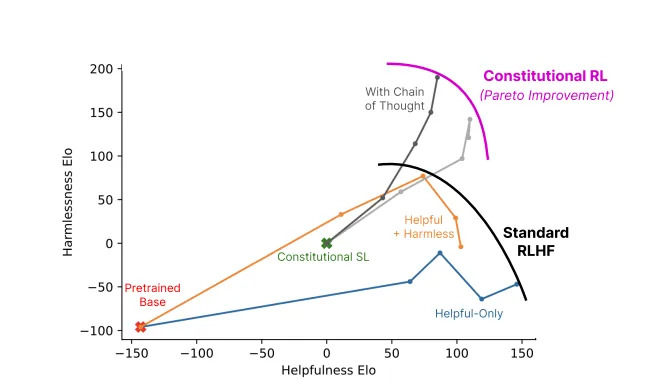
Claude from Anthropic reminds us that the development of artificial intelligence is not just a technological race, but also a philosophical journey.
Claude argues that it's not just about creating a "smarter" AI; it's also about experimenting with creating an AI that can grasp the fine line between right and wrong, for cutting-edge researchers.
Compiled by: Serap Atabey
For just 1 TL per day, subscribe and gain unlimited access to all our content and support independent journalism! Subscribe Now!