Major Mathematical Discovery: The Ninth Dedekind Number Discovered After 32 Years
After thirty years of research, mathematicians, aided by a supercomputer, made a groundbreaking discovery: a new Dedekind number, D(9). Calculating D(9) is almost impossible, but the team overcame this challenge with a supercomputer called Noctua 2. Although D(10) has not yet been mentioned, it is estimated that it may take 32 years to discover it.

- After thirty years of research, mathematicians made a groundbreaking discovery with the help of a supercomputer: a new Dedekind number, D(9).
- Calculating D(9) is almost impossible, but the team overcame this challenge with a supercomputer called Noctua 2.
- Although D(10) has not yet been mentioned, it is estimated that it may take 32 years to discover it.
Dedekind numbers consist of special integers that are difficult to understand and calculate. This makes their discovery a significant achievement. D(9) is a very large 42-digit number calculated as 286 386 577 668 298 411 128 469 151 667 598 498 812 366. This number comes after D(8), which was discovered in 1991 and has 23 digits.
Dedekind numbers are difficult to understand, even for mathematicians. At their heart are Boolean functions, a type of logic that produces an output based on binary inputs (0 and 1 or true and false).
Researchers use an n-dimensional cube analogy to conceptualize uniform Boolean functions in multiple dimensions. They imagine balancing the cube at one corner and painting the remaining corners red or white. The rule is never to place a white corner on top of a red corner, creating vertical red-white intersections. The goal is to count the number of different intersections.
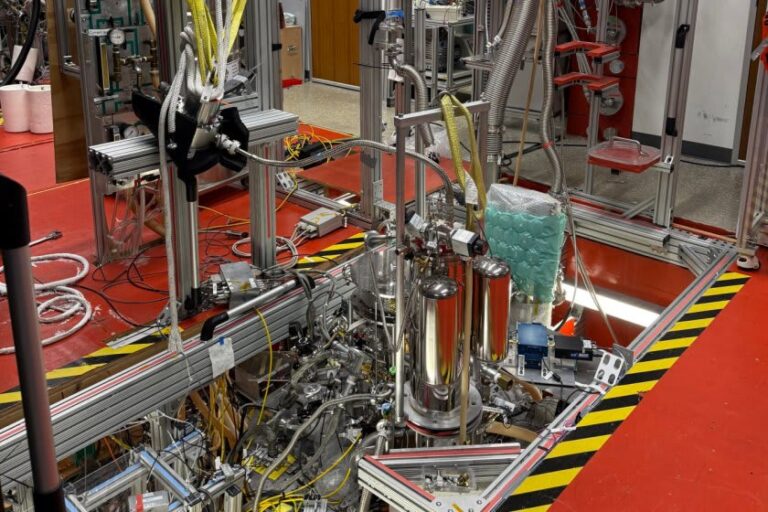
Calculating D(9) seemed almost impossible due to the complexity and enormous numbers involved. However, the team overcame this challenge using a supercomputer called Noctua 2 at the University of Paderborn. Noctua 2 uses special units called Field Programmable Gate Arrays (FPGAs) to perform parallel computations. By optimizing the formula using symmetries, the researchers enabled Noctua 2 to solve a large sum of approximately 5,5*10^18 terms.
After five months of calculations, Noctua 2 successfully identified D(9). Although the researchers have not yet mentioned D(10), it is estimated that its discovery could take another 32 years. The findings will be presented at the International Workshop on Boolean Functions and Applications in September. Although no official paper has been published on this research, the discovery of D(9) is a significant milestone in the field of mathematics and computation.
Compiled by: Merve Nur Sözen
For just 1 TL per day, subscribe and gain unlimited access to all our content and support independent journalism! Subscribe Now!